The $345 Belt and the $1,200 Belt Feel Almost Identical. I Spent Three Months Figuring Out Why.

I was holding two belts at Bergdorf, one in each hand, and I did this thing where I closed my eyes. Like a wine tasting but for leather. Which sounds ridiculous, I know. The Toteme was in my left hand. The Hermes Constance in my right. And honestly? I couldn't tell which one cost more.
Not even close.
The woman next to me, Celeste, had been talking my ear off about a scarf return (her husband bought the wrong colorway, she was very calm about it, I would not have been). She watched me do the closed-eyes thing and just went, "Buy the cheaper one. You're being insane." She wasn't wrong.
But I couldn't let it go because belts are this weird blind spot in luxury fashion. Everyone has opinions about bags. Shoes get debated constantly. Belts? People either buy a $30 one at Zara and forget about it, or they walk into Hermes and spend $1,200 and feel vaguely guilty. The middle ground barely gets discussed, which is strange because that's where most of the interesting stuff is happening.
So I spent, I don't know, three months after that Bergdorf trip being kind of obsessed. I borrowed belts from friends (people are weirdly possessive about lending belts, by the way, more than bags even). I went to stores and did the thing where you ask to "just feel the leather" and then stand there for ten minutes and leave. My friend Astrid works in leather goods sourcing, she fell into it sideways after a ceramics career that didn't go anywhere, and she let me come to her office and handle these tannery swatches from Italy and Spain. She gets them the way some people get wine samples. Astrid told me something I keep coming back to: "Above $300, you're mostly paying for the buckle."
I don't know if that's entirely true. But it's closer to true than I expected.
Why Luxury Belts Are the Most Underrated Investment Accessory
The quality gap with belts is not like bags where you can argue about it. It's physical. You pick up a $50 belt and then you pick up a $400 one and your hands just know. The expensive one has this weight to it, the edges feel finished instead of rough, and when you bend it the leather responds differently. I'm not being precious about this. It's a really obvious difference.
And look, the timing is interesting because belts are suddenly everywhere again. That belt over shirt thing, you know, cinching a slim belt over a big button-down or a cardigan, it's been creeping up since maybe late 2024 and now I see it constantly. My coworker does it. The barista at my coffee shop does it. I saw a woman on the subway last week wearing a Toteme belt over what I'm pretty sure was a men's Oxford shirt and she looked incredible. Even cashmere scarves are showing up paired with belted looks now, which I did not see coming.
The reason it works, I think, is because you're adding one sharp line to something soft. A $400 belt on a $60 oversized shirt and suddenly the whole outfit has a point of view. It's cheaper than buying a blazer and arguably does more. If you've been paying attention to where quiet luxury clothing brands are going, this belt thing is a big part of it.
The problem is nobody tells you what to actually buy. There's a $30 option and a $3,000 option and this massive gap in between where most of the good belts live, but good luck finding anyone who breaks it down clearly. I couldn't find that guide when I needed it, so I guess this is it.
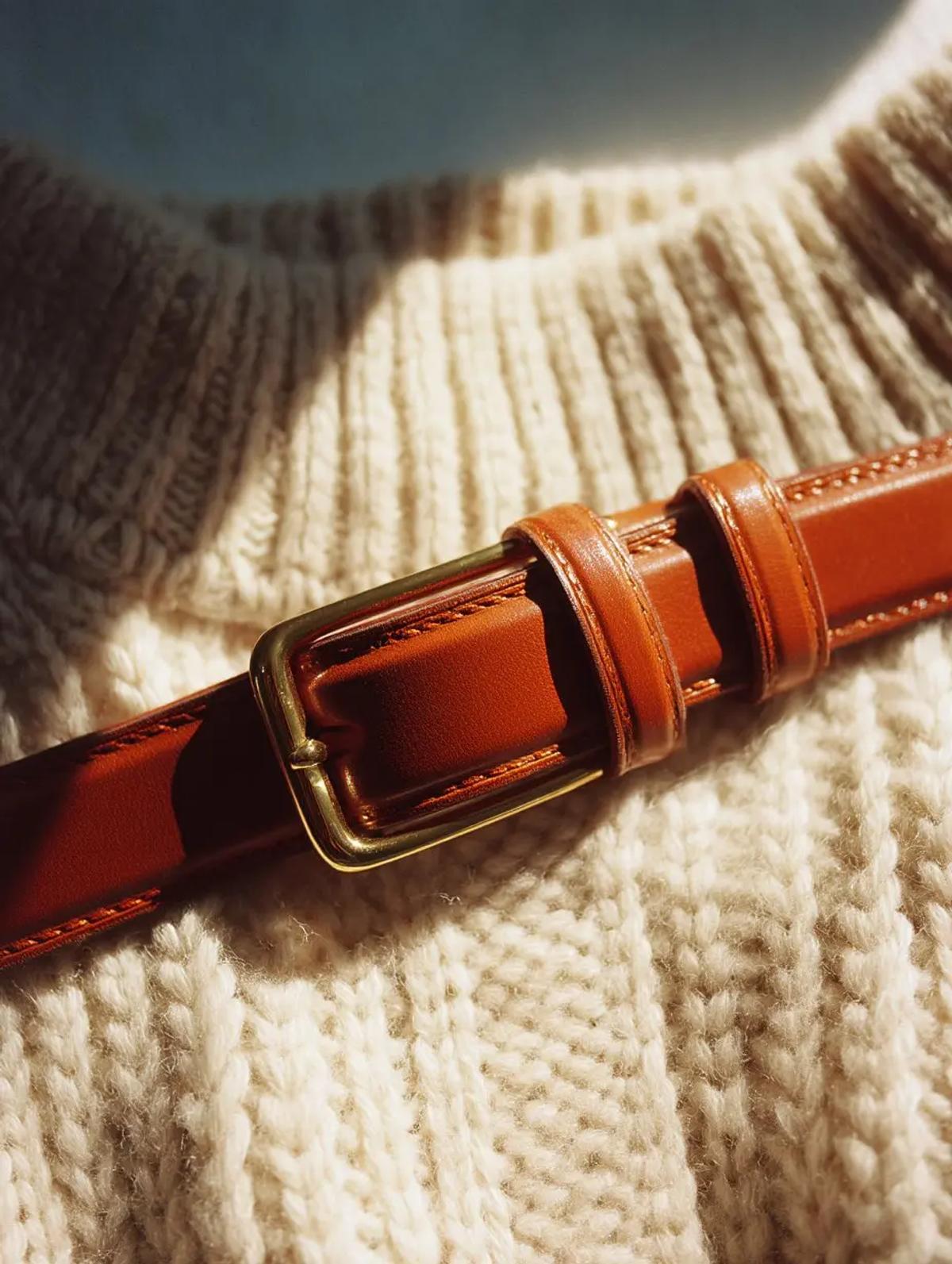
The Best Designer Belts for Women, Ranked
I'm going by price tier here because, I mean, that's how this works in real life. You know what you can spend before you know what brand you want. At least I do.
Ultra-Luxury: The $900+ Belts
Hermes Constance Belt (around $1,100 to $1,500 depending on width and leather)
Okay look. The Constance is the standard. The small H buckle reads as jewelry, not logo, which is why this belt has outlived about fifteen trend cycles without ever looking dated. It's reversible, two colors in one belt, and comes in multiple widths. Box calf and Epsom are the most popular leathers. Available on hermes.com, Hermes boutiques, The RealReal and Vestiaire Collective for pre-owned.
What are you actually paying for? I asked Astrid this directly. She said the edge finishing on Hermes belts is hand-painted, the stitching is saddle-stitched by hand, and the buckle has what she called "real density." I picked up a Constance and then a mid-range belt right after and, yeah. You can feel the buckle weight difference. It's not subtle. Resale holds at around 70 to 80 percent on The RealReal for popular colorways, which is kind of remarkable for a belt. If you're familiar with how investment bags hold value, this is the belt equivalent.
The catch: you often need a boutique appointment. And the price keeps climbing.
Bottega Veneta Intrecciato Belt (around $550 to $750)
The woven leather Intrecciato is one of those if-you-know-you-know pieces. No logo, no hardware doing the heavy lifting. Just hand-woven calfskin that's buttery soft and recognizable to exactly the right people. Available on bottegaveneta.com, Saks Fifth Avenue, Net-a-Porter, and Mytheresa.
I tried one on at Saks and was surprised by how comfortable it was. The weave gives it this slight flexibility that rigid belts don't have. It kind of moves with you. Resale is moderate, around 40 to 50 percent, which is standard for non-Hermes luxury belts.
Premium Tier: $300 to $600 (The Sweet Spot, Honestly)
This is where I'd tell most people to look. The jump in leather quality from anything under $200 to this range is enormous, like you can feel it in the first second. The jump from this tier to $1,200? Real, but honestly smaller than you'd think for that price gap.
Khaite Benny Belt (around $520)
The Khaite Benny Belt is the belt of the moment and I kind of hate admitting that because I'm suspicious of anything that's "the belt of the moment." But I held one at Hirshleifers and the hardware genuinely surprised me. It's heavier and more sculptural than it has any right to be at this price. The buckle, the loop, the tip, they all feel like jewelry rather than belt hardware. Available on khaite.com, NET-A-PORTER, Farfetch, SSENSE, and Hirshleifers.
Available in plain calfskin or with these disc-shaped studs that give it a Western edge. Black leather and coffee suede are the core options. Celeste, the Bergdorf scarf-returner, actually owns one. She told me later (we exchanged numbers, she's great) that she gets compliments on the buckle specifically more than any other accessory she owns.
Sizing thing to know: Khaite uses XS/S and M/L instead of standard measurements, and several people I talked to mentioned the belt tail hanging awkwardly depending on your pant rise. Check the sizing guide before ordering. If you want more context on the brand overall, I wrote a whole deep dive into Khaite's pricing and quality.
Chloe The Chloe Iconic Belt (around $545)
A wider belt with Chloe's signature curved C hardware in gold-tone. Smooth calfskin, made in Italy. The hardware is substantial but not aggressive, which is a balance that's harder to strike than it sounds. This belt defines a waist without announcing itself.
I'll be honest, I haven't spent as much time with this one as the others. A friend's friend had one at a dinner and I asked to look at it (yes, I'm that person now). The leather was beautiful but the wider width makes it less versatile for the belt-over-shirt trend.
Loewe Anagram Belt (around $495)
Reversible with Loewe's anagram logo buckle. Two looks in one, calfskin, made in Spain. The anagram sits in this sweet spot where it's subtle enough for the quiet luxury crowd but recognizable if you're paying attention.
I almost bought this one. Almost. The reversibility is genuinely useful and the Spanish leather has a slightly different hand-feel than the Italian stuff. Warmer, somehow. Astrid would probably explain the tanning process difference but I'll spare you.
Toteme Croc-Effect Belt (around $345)
The most affordable belt in the premium tier and maybe the best value on this entire list. Croc-embossed leather with a clean, minimal buckle that does absolutely nothing to draw attention to itself. Toteme does hardware the same way they do everything else. Barely there. If you've read my take on Toteme's coats, you know I think this brand punches absurdly above its price point. Their belts are no different. Made in Italy.
This is the belt I was holding in my left hand at Bergdorf. The one that felt, eyes closed, nearly identical to a belt three times its price.
Valentino VLogo Signature Belt (around $520)
The V-shaped logo buckle in polished metal is more branded than everything else on this list. But the V is geometric enough to read as design rather than billboard. 3cm width, calfskin, made in Italy. I'll say this: if you want people to notice your belt, this is the one. The others are for people who want their belt to disappear.
Accessible Luxury: Under $300
A.P.C. Paris Belt (around $195 to $250)
A.P.C. has been making clean leather belts with minimal buckles for literally decades. Italian leather, simple buckle, zero ornamentation. These are the belts that make people ask "wait, where is that from?" because they're quiet in a way that reads as intentional.
I own one. Have for two years. The leather has developed this patina that makes it look better now than when I bought it, which is pretty much the definition of a good leather belt.
DeMellier Belts (around $165 to $225)
DeMellier has expanded from bags into belts and the quality tracks with what they do in their bag line, which is high for the price point. Good option if you already own DeMellier bags and want hardware that matches. I wrote about DeMellier's bags extensively and the leather sourcing is the same for their belt collection.
COS Leather Belt (around $69 to $119)
Okay so COS belts are genuine leather with minimal buckles at a price where you can experiment without stress. The leather IS thinner. The edge finishing IS machine-done. You will notice the difference if you put it next to a Khaite or a Toteme.
But. If you're trying belt-over-shirt styling for the first time and you don't want to spend $500 figuring out if you even like it? Start here. Seriously. Nobody is going to know.
How to Wear a Belt Over a Shirt
Okay since I keep bringing it up I should probably explain what I mean. The belt over shirt trend is basically just taking a relaxed top, whatever, a big button-down or a cardigan that's kind of shapeless on its own, and putting a slim belt at your waist. That's it. The whole trick. It sounds too simple to work but the physics of it are real. One point of tension changes the entire silhouette.
The belt should be thin, like 2 to 3cm, anything thicker gets bulky over fabric. And you want it at your actual waist, the narrow part, not down on your hips. Tucking the shirt underneath helps but isn't mandatory. I've seen it look great on button-downs, on those long knit cardigans, on oversized blazers. Astrid even does it over a light trench coat which I thought would look weird but it doesn't.
I tried it once with a wider belt, like a 4cm one, and it looked like I was wearing a costume. That's the main thing to avoid. Wide belts over shirts just read as dress-up. And if the belt sits too low on your hips it's a completely different look, more 2003 than 2026, you know?
For this specific styling, the Toteme and the A.P.C. are my picks because they're thin enough and soft enough to actually wrap around fabric without creating this weird stiff ridge. The Chloe is gorgeous but it's wider, better for jeans and trousers.
What the Best Belt Brands Have in Common
After spending three months being, frankly, kind of annoying in department stores, the pattern I noticed is less about specific brands and more about materials. The belts I kept reaching for all had Italian or Spanish leather (there's a difference in feel but both are good). The hardware was solid metal with actual weight, not that hollow plated stuff that chips after six months. And the edges, this is the thing Astrid taught me to look for, were either hand-finished or at least properly beveled. You run your finger along the edge of a cheap belt and it's rough. A good one feels smooth and slightly rounded.
The brands that consistently hit those marks, at least from what I've handled: Khaite, Bottega Veneta, Loewe, Toteme, Chloe, Hermes obviously, A.P.C., DeMellier, The Row, and Valentino. Not an exhaustive list, just the ones I personally put my hands on.
And then there are the ones I'd skip for this particular thing. Gucci's GG belt is iconic, sure, but you're paying for that logo to be visible and that's a different purchase than what I'm talking about here. Same with Louis Vuitton. Versace makes incredible statement pieces but "investment everyday belt" is not what they're going for.
Right, so here's the uncomfortable part. Unlike bags, luxury belts basically have no resale value. I checked. Nobody is paying 80% of retail for a secondhand Khaite Benny. That just isn't happening. Hermes is the exception because Hermes is always the exception.
So the investment argument comes down to how often you wear the thing. I did the math on my Toteme because I'm like that. $345, I wear it probably three or four times a week, it's been five months. That's already under $4 per wear and dropping. The $30 belt I had before it literally cracked at the holes after six months and I had to buy another one. So which one actually cost more? I don't know, I think people overthink the "investment" framing with accessories. Just buy the one you'll actually reach for. That's what makes your closet work, same reason a good investment bag changes how you get dressed in the morning.
The Belt I Actually Bought (and the One I Didn't)
I bought the Toteme. The $345 croc-effect belt that started this whole thing in Bergdorf.
I did not buy the Hermes Constance, even though I think about it more than is probably normal. The quality difference is real. I'm not going to pretend it isn't. But Astrid's comment stuck with me. Above $300, you're mostly paying for the buckle. And I don't know, the Toteme buckle doesn't bother me. It does its job and disappears.
Celeste texted me last week. She bought the Constance. Of course she did. She said the H buckle "makes her feel like she has her life together," which is honestly the most compelling product review I've ever heard.
I still don't know if she's right or if I am. Probably depends on whether you want your belt to make you feel something or just hold your pants up beautifully.
What about you?
Frequently Asked Questions About Designer Belts
What is the best belt brand for women?
For quiet luxury and everyday versatility, Khaite and Toteme lead in 2026. For heritage and resale value, Hermes is unmatched. For the best balance of price and quality, A.P.C. and DeMellier are hard to beat.
Are designer belts worth it?
The leather quality difference between a $50 belt and a $345+ belt is significant and immediately noticeable. The gap between $500 and $1,200 is smaller but still real, primarily in hardware quality and edge finishing. Designer belts don't hold resale value like bags, so the investment is in daily use and longevity.
What width belt is most versatile?
2.5cm to 3cm. Wide enough to define a waist, narrow enough to work with belt loops on jeans and trousers, and slim enough to wear over shirts and cardigans.
Can you wear a belt over a shirt?
Yes, and it's one of the biggest styling moves of 2026. Use a slim leather belt (2 to 3cm) positioned at the natural waist over an oversized button-down, cardigan, or relaxed blazer. This creates definition without tucking.
What are the most popular belts right now?
The Khaite Benny Belt (with and without studs), Bottega Veneta Intrecciato, Hermes Constance, and Toteme croc-effect belt are the most searched and discussed luxury designer belts in 2026.
Khaite Benny Belt
Where to Buy
Disclosure: This article may contain affiliate links. If you purchase through these links, InvestedLuxury may earn a commission at no additional cost to you. We only recommend products we genuinely believe in.
Written by
Regi
Luxury fashion and lifestyle writer. Years of buying, wearing, and reselling luxury pieces. Based in Europe. Obsessed with quality. Skeptical of trends.


